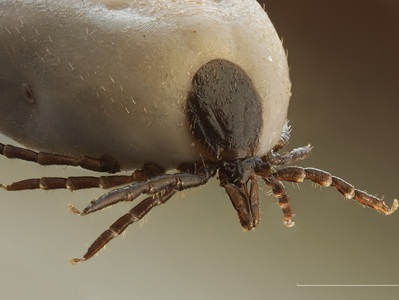
Ixodes Ricinus. Credit: Richard Bartz
As the threat of ticks and tick-borne diseases grows, farmers and outdoor workers in the Northeast are being hit the hardest, according to a new study published in Journal of Agromedicine.
“Not much has been done in the Northeast United States with outdoor workers and tick-borne diseases since the early 90s,” said study author Mandy Roome, associate director of the Tick-borne Disease Center at Binghamton University. “Ticks and tick-borne diseases were a very different risk in the early 90s than they are now. We wanted to figure out how we can help some of our most vulnerable workers.”
Roome and her team connected with 53 individuals, representing a total of 46 farms in Southern Vermont. The questionnaire collected data on tick bites, health history, prevention practices, farm activities and more.
The survey revealed that, over the previous 6 months, participants reported an average of three tick encounters, while some workers reported as many as 70 encounters. There was a marginal association between grazing livestock and increased tick sightings. One farmer in the study had contracted Lyme carditis, a serious bacterial infection of the heart, for which he eventually needed to have open-heart surgery.
“These are the things that we would like to prevent,” said Roome. “For anybody that's detrimental, but especially for a farmer—not being able to do that work can have massive consequences on the whole farm.”
The research is part of a larger project aimed at testing an environmental intervention. Roome and her team are trialing tick control tubes that will help kill ticks on mice, which are the number one reservoir for transmitting pathogens to humans.
Data from Binghamton University