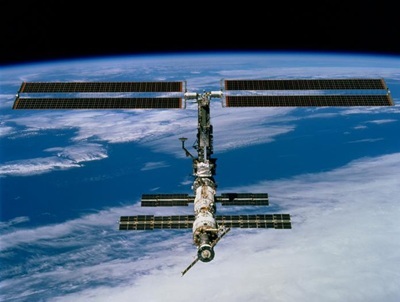
ISS. Credit: NASA
Interactions between phages—viruses that infect bacteria—and their hosts play an integral role in microbial ecosystems. Often described as being in an evolutionary “arms race,” bacteria can evolve defenses against phages, while phages develop new ways to thwart defenses.
While virus-bacteria interactions have been studied extensively on Earth, microgravity conditions alter bacterial physiology and the physics of virus-bacteria collisions, disrupting typical interactions.
A new study shows terrestrial bacteria-infecting viruses were still able to infect their E. coli hosts in microgravity conditions aboard the International Space Station, but the dynamics of virus-bacteria interactions differed from those observed on Earth.
For the study, published in PLOS Biology, Huss and colleagues compared two sets of bacterial E. coli samples infected with a phage known as T7—one set incubated on Earth and the other aboard the International Space Station.
Analysis of the space-station samples showed that, after an initial delay, the T7 phage successfully infected the E. coli. However, whole-genome sequencing revealed marked differences in both bacterial and viral genetic mutations between the Earth samples versus the microgravity samples.
The space-station phages gradually accumulated specific mutations that could boost phage infectivity or their ability to bind receptors on bacterial cells. Meanwhile, the space-station E. coli accumulated mutations that could protect against phages and enhance survival success in near-weightless conditions.
The researchers then applied a high-throughput technique known as deep mutational scanning to more closely examine changes in the T7 receptor binding protein, which plays a key role in infection, revealing further significant differences between microgravity versus Earth conditions. Additional experiments on Earth linked these microgravity-associated changes in the receptor binding protein to increased activity against E. coli strains that cause urinary tract infections in humans and are normally resistant to T7.
Overall, the study highlights the potential for phage research aboard the ISS to reveal new insights into microbial adaption, with potential relevance to both space exploration and human health.
Data from PLOS