Breaking exhibitor and attendance records, SLAS (Society for Laboratory Automation and Screening) hosted 419 exhibitors and more than 7,600 registrants from 47 countries at its 2026 conference from February 7 to 11 in Boston.
Held annually, SLAS is North America’s largest gathering of laboratory automation providers and users of these products for life sciences research. Its mission is to bring together researchers in academia, industry and government to advance life sciences discovery and technology via education, knowledge exchange and global community building.
At each conference, SLAS presents up to three New Product Awards to exhibitors. These are the 2026 winners:
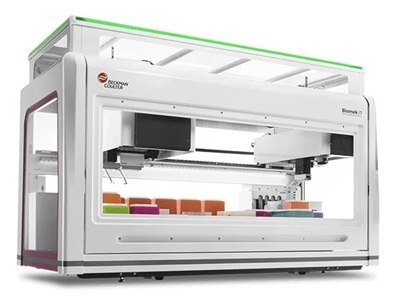
- Beckman Coulter Life Sciences in collaboration with HSE-AG, for the eviDense UV Photometer. The integration of the HSE eviDense UV Photometer with Biomek i-Series automated workstations from Beckman Coulter allows for real-time absorbance measurements directly in the liquid handling process. This innovation provides faster, more efficient results while minimizing the need for manual intervention.
- BioDot’s Nanolab is a high-precision liquid handling system engineered for advanced genomics workflows that demand ultra-low-volume accuracy. BioDot was selected because this product solves the engineering challenge of using plastic tips for small-volume dispenses. Between runs, contamination concerns and cleaning steps can slow teams down. A disposable-tip approach is intended to reduce operational overhead and help teams move faster when switching between workflows, especially in environments handling multiple chemistries and assay types.
- Emulate’s AVA Emulation System, a next-generation Organ-Chip platform that’s engineered to make human-relevant in vitro biology accessible, scalable and automation-ready. AVA is the first self-contained Organ-on-a-Chip workstation to fuse high-throughput microfluidic tissue culture, full environmental control, and real-time imaging into a single, compact benchtop unit. 96 independent Organ-Chip samples in a single run enable researchers to achieve microplate-level scale of their Organ-Chip experiments, enabling side-by-side comparison of dozens of compounds, doses, or stimuli. Hands-on, in-lab time is reduced by more than half, thanks to automate capabilities.
Additional new products on display at SLAS 2026 include:
Chromatography
Shimadzu Scientific Instruments’ Nexera ion chromatograph (IC) is a compact, fully automated system designed to streamline water quality testing while delivering accurate, reliable results for users of all experience levels. Engineered for both routine and regulated samples, the Nexera IC combines advanced automation, intuitive software and a space-saving design to reduce manual effort and maintain consistent analytical performance. Essential functions are integrated into a single-analysis system, while an optional dual injection configuration enables simultaneous anion and cation analysis, expanding throughput and versatility for drinking water and environmental testing. Preprogrammed sample preparation ensures dilution and eluent mixing occur automatically prior to injection, eliminating variability and supporting consistent analysis.
Liquid handling
Analytik Jena launched the PULSEspencer R, a new digital and contactless dispenser. The PULSEspencer R enables precise dispensing of liquids such as DMSO, water, small molecules, and biomolecules using disposable syringes. The system is based on three key principles: miniaturization, direct dilution, and rapid volume distribution. These features help to streamline workflows and reduce resource consumption. Benefits include: faster assay setups thanks to intuitive software and contactless dispensing; miniaturization that saves reagents and reduces waste; and a compact design for flexible integration into any laboratory.
nNano debuted the CERTUS RIVO, a 16-channel contactless dispenser designed for precise low-volume applications. It offers reliable on-the-fly dispensing, back-flush functionality for less sedimentation, enhanced volumetric accuracy and an improved sensory system for even more consistent results. CERTUS RIVO supports a wide range of assay formats, plate types, and dispensing strategies, enabling scientists to configure workflows exactly to their experimental needs. Variable volumes, independent channel control, and contactless dispensing provide the freedom to design complex layouts, miniaturize protocols, and rapidly iterate assay conditions without compromising accuracy or reproducibility.
Revvity’s AssayMate is a compact, benchtop liquid handler that delivers intelligent automation performance for labs of any size. It supports a wide volume range of 3–1000 µL without requiring head changes, using a fixed 8-channel head and gripper configuration. Intelligent features such as pressure-based liquid level detection (PLLD) and built-in workflow error handling—including detection of missing plate lids—enable reliable operation and quick experiment resumption. A reconfigurable recessed deck accommodates optional modules such as heater shakers, heater coolers, and magnetic blocks, while AssayPREP software provides a user-friendly, drag-and-drop interface that requires minimal training.
Partnerships and collaborations
Gator Bio and Hudson Lab Automation have integrated the Gator Bio Pivot and Pro BLI with the PlateCrane automation platform to deliver a production-ready solution that can increase sample throughput from 400 to 1,200+ samples per day—a 3x capacity increase depending on workflow configuration. This addresses a critical bottleneck for organizations scaling antibody discovery programs, particularly those leveraging AI-designed antibody libraries that generate thousands of candidates requiring rapid characterization. The solution is particularly well-suited for organizations working with AI-designed antibody libraries, which can generate thousands of candidates requiring characterization.
HighRes and Opentrons Labworks announced a strategic partnership to co-develop and demonstrate the industry’s first AI agent-to-agent laboratory workflow. Together, the companies are introducing a new model for workflow automation that connects intuitive, modular robotics with enterprise-grade orchestration and AI-ready infrastructure. This collaboration brings Opentrons’ flexible, high-throughput Opentrons Flexrobotic platforms and OpentronsAI, together with the FlexPod Configurable Lab Automation Platform and Cellario, HighRes’ scheduling and orchestration software, enabling scientists to adopt automation quickly and scale seamlessly as workflows grow in complexity.
Opentrons also announced a partnership with NVIDIA to accelerate the development and deployment of physical AI-enabled laboratory robotics. Through this integration, Opentrons is using NVIDIA Isaac and NVIDIA Cosmos platforms to develop training data for physical AI models purpose-built for laboratory environments. NVIDIA’s BioNeMo provides the foundation for training and deploying AI models for biological discovery, while Opentrons supplies the standardized physical execution layer required to close the loop between digital design and experimental validation.