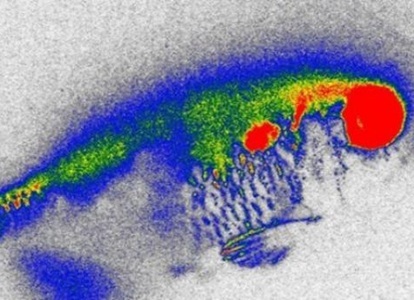
X-ray of a lambari fish contaminated with carbon-14-radiolabeled enrofloxacin. The color indicates the radiative intensity of the signal, ranging from low (blue) to high (red). Credit: Patrícia Alexandre Evangelista
An analysis of a dam in Brazil has revealed extensive antibiotic residue in water causing genetic damage in fish. But, the study also discovered an aquatic plant—previously considered a pest—that can help reduce pollution and damage.
For the study, published in Environmental Science Europe, researchers with the Sao Paulo Research Foundation collected samples from the region of the Santa Maria da Serra dam, near the Barra Bonita reservoir, where pollutants from the entire Piracicaba River basin accumulate.
Water, sediment and fish samples were collected and analyzed during both the rainy season and the dry season. In total, the researchers detected 12 antibiotics from widely used classes—including enrofloxacin and chloramphenicol at higher levels than reported in previous studies.
“One of the most significant findings of the study was the detection of chloramphenicol in lambari fish (Astyanax sp.) collected from local fishermen in the Barra Bonita region. Chloramphenicol is an antibiotic whose use in livestock is prohibited in Brazil precisely because of the risks associated with its toxicity,” said lead author Patricia Alexandre Evangelista.
While the antibiotic was found in the fish only during the dry season, lambari fish is widely sold and consumed locally, indicating a possible route of human exposure.
Chloramphenicol was also found to significantly increase DNA damage in fish. However, when Salvinia auriculata was present in the system of the fish, the damage was greatly reduced, with levels similar to the control group.
Salvinia auriculata is a floating macrophyte previously considered a water body pest. But, in laboratory tests when researchers exposed the plant to extremely high concentrations of chloramphenicol and enrofloxacin, the plant showed removal properties.
The study results showed Salvinia removed more than 95% of enrofloxacin from the water within a few days. The half-life of the compound also dropped to two to three days. For chloramphenicol, removal was slower and partial. The plant removed 30 to 45% of the antibiotic from the water, with half-lives ranging from 16 to 20 days.
However, reducing antibiotic concentration in water does not necessarily result in lower bioaccumulation in fish species, as the study uncovered. According to the data, enrofloxacin dissolved in the water and was quickly eliminated by the lambari, with a half-life of about 21 days.
Chloramphenicol, on the other hand, showed greater persistence in the organism, with a half-life exceeding 90 days and a high bioconcentration factor. Additionally, with Salvinia auriculata present, researchers occasionally recorded an increase in absorption rate by the fish. One hypothesis is that the plant may partially transform the original compound, making it more bioavailable even at lower total concentrations.
“This shows that using plants as ‘sponges’ for contaminants is not a trivial matter. The presence of the macrophyte changes the entire system, including the way the organism comes into contact with the contaminant,” said Evangelista.
The research team concluded that while Salvinia auriculata should not be viewed as a one-stop solution to antibiotic pollution, their study results suggest that aquatic macrophytes are a viable option for incorporation into larger nature-based mitigation strategies.
“The study shows that the problem is real, measurable, and complex. And any strategy to address it must consider not only the removal of the contaminant, but also its biological and ecological effects,” said Evangelista.