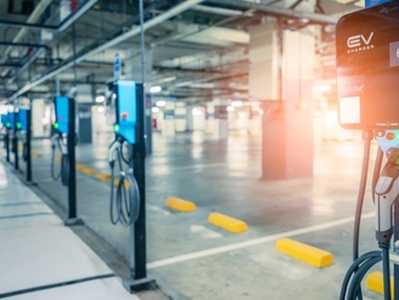
A new assessment of electric vehicles’ charging strategies suggests that EVs could serve as a vast network of mobile batteries, storing excess energy and feeding it back into the country’s grid when demand surges.
Vehicle-to-grid (V2G) technology—software that allows charging stations to communicate with the grid—bridges both challenges, allowing EVs to both draw power and send it back when needed. This two-way energy flow contrasts with current charging systems, where electricity flows only from the grid to the vehicle. However, there are concerns about the feasibility of large-scale V2G deployment and the high upfront costs of the necessary infrastructure.
To assess the real-world potential of V2G, researchers examined the San Francisco Bay Area under different grid scenarios. They projected EV ownership and solar energy adoption, mapped when and where vehicles would charge, and evaluated the cost-effectiveness of upgrading the grid proactively versus in phases.
According to the paper published in Joule, if the grid is updated proactively, each charger would need to generate just $0.12 to $0.18 per day to offset V2G costs, compared with $1.49 to $1.78 under phased updates. Under California’s proposed decarbonization policies, the model estimates that annual carbon emissions between 2030 and 2045 could be reduced by up to 59,200 metric tons of CO2 equivalent with V2G and proactive upgrades. The strategy could also yield up to $47.5 million in cumulative carbon rebate revenue, supporting the economic case for V2G adoption.
“First, we need to upgrade the power system to support incoming electric vehicles,” says Song. “Then we can scale V2G when needed. That’s really the key message.” Major grid assets, such as transformers, last for decades, while V2G chargers have a limited lifetime and can be scaled up as EV adoption grows.
The team notes that much of their work relies on forecasts, such as how many EVs will be on the road in 20 or 30 years, what policies will look like, and how quickly rooftop solar will spread. Political shifts, especially regarding EV incentives, could change the timeline.
Data from Cell Press