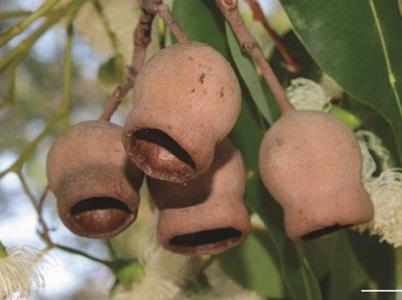
The image shows a nut hanging from its mother tree. Recorded by D. Blumer and reproduced with permission of the Botanic Gardens and Parks Authority. Credit: D. Blumer and reproduced with permission of the Botanic Gardens and Parks Authority.
Researchers at NYU Abu Dhabi have uncovered the secret behind the remarkable toughness of the marri nut, the hard seed of the marri tree native to Western Australia. The nut’s shell is so strong that even natural predators struggle to break it. By studying how it absorbs impact and resists cracking, the team discovered a clever natural design that could inspire new materials of protective gear and other safety applications.
The study, published in Advanced Science, shows that the marri nut’s strength comes from a layered internal structure that combines a tough outer shell with a softer, flexible interior. This combination of hardness and flexibility allows the nut to absorb energy without shattering, distributing force in a controlled way rather than breaking suddenly.
“Nature shows us that materials do not need to be simply hard to be strong,” said Panče Naumov, professor of chemistry at NYU Abu Dhabi, who led the study. “The marri nut survives by using structure to its advantage, absorbing energy and directing cracks in a controlled way instead of letting them spread.”
The research, conducted over five years, used advanced 3D imaging and mechanical testing to examine how the nut behaves under pressure. Despite being largely made of cellulose—a natural plant material—the nut displayed a rare combination of properties: it can deform and absorb energy like Teflon, while maintaining stiffness similar to acrylic, all while remaining lightweight.
Inspired by the nut’s design, the researchers created a bioinspired material that mimics its internal structure.
The work demonstrates how natural designs that evolved over millions of years can guide the development of materials that are both lightweight and impact-resistant.
Data from NYU Abu Dhabi