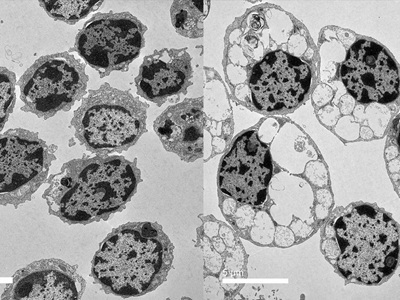
Microglia cells from the brain of a healthy mouse, left, and microglia cells clogged with cellular waste from a mouse model of Sanfilippo syndrome type A (MPS IIIA), right. Photo credit: UC San Diego Health Sciences
Children born with Sanfilippo syndrome type A face seizures and dementia so severe that most die before adulthood. Researchers at University of California San Diego have now found that the same cellular switch driving destruction in these children's brains also flips on in Alzheimer's disease, suggesting the two conditions—one rare and genetic, one common and tied to aging—share a common root cause inside the brain's immune cells.
Sanfilippo syndrome type A, also called Mucopolysaccharidosis Type IIIA, is caused by a single gene variant that blocks production of an enzyme called sulfamidase. Normally, tiny structures within cells called lysosomes use sulfamidase to break down nutrients into usable energy, destroy harmful invaders like bacteria, and recycle old cell parts for reuse. In the absence of the enzyme, debris accumulates.
Using a mouse model of the disorder, the researchers found that although this waste accumulates across many cell types, microglia bear the brunt of the damage. As these cells become clogged with fats and proteins, they swell and lose their ability to protect neurons.
For the study, published in Immunity, researchers from UCSD identified a family of proteins called MITF/TFE that function as master genetic switches inside microglia. When lysosomes become overloaded and stressed, these switches flip from off to on, setting off a sweeping change in the cells' genetic programming meant to protect the brain.
Over time, that same response turns harmful, driving inflammation and contributing to the death of neurons. Strikingly, the team found the identical MITF/TFE switches activated in microglia from human Alzheimer's patients, pointing to a shared mechanism between the rare pediatric disease and the far more common neurodegenerative condition of old age.
Many scientists have theorized that amyloid plaques, which sit outside microglia, cause lysosomes to fail from the outside in. This study suggests otherwise.
“We show in this paper that the damage can come directly from inside the cell,”said Christopher Balak, first author and a post-doctoral researcher at UC San Diego School of Medicine. “We know lysosomes alone are sufficient to cause neurodegeneration from rare disorders like MPS IIIA. The same thing could be happening in, or at least contributing to, major diseases like Alzheimer's disease.”
Because the MITF/TFE proteins appear to drive the process, the findings point researchers toward a new target for drug development — one focused inside the cell rather than on its surface.
"Most microglia-targeted drugs go after receptors on the cell surface," Balak said. "I think this work points to a little bit of a different strategy, instead going after the lysosomal program inside the cell."
The team also observed that microglia work to limit damage early in the disease process, before the cells become overwhelmed and the genetic switch flips them into a harmful state. That timing detail carries significance for treatment: it suggests that therapies such as enzyme replacement or cell-based treatments may work best if delivered early, before microglia cross that threshold into a damaging mode.
With a rare, single-gene disorder like MPS IIIA offering a cleaner model than the more complex biology of Alzheimer's, the researchers say their study provides a roadmap for testing interventions and tracing how the same lysosomal breakdown might unfold in aging brains more broadly.
Data from UCSD