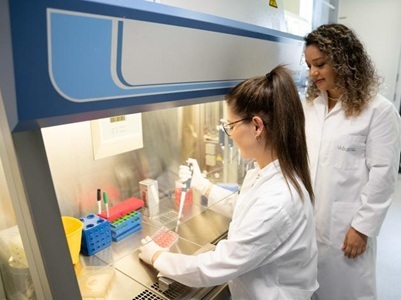
Julia Nicke (left) and Dr. Mona Malek Mohammadi (right) have identified a previously unknown signaling pathway in the immune system that helps newborn heart cells survive and regenerate after injury. © Photo: UKB/Alessandro Winkler
Researchers have identified a previously unknown immune signaling pathway that helps newborn heart cells survive and regenerate after injury, a discovery that could point toward future therapies for repairing damaged adult hearts.
For the study, published in Cell Communication and Signaling, researchers at the University Hospital of Bonn and the University of Bonn examined how the hearts of newborn mice respond to both direct injury and pressure overload, a condition that mimics the chronic stress placed on a struggling heart. Unlike adult hearts, newborn mammalian hearts can briefly regenerate after damage, though that ability disappears within days of birth. The team traced how immune cells communicate with heart muscle cells during this brief regenerative window.
They found that three immune-related signaling molecules—CCL4, S100A8 and C1QA—work together to activate a receptor called TLR2 on heart muscle cells. Once activated, this pathway boosted heart cell proliferation, improved the survival of heart muscle cells and reduced cell death.
To confirm TLR2's role, the team studied genetically modified mice lacking the receptor and found that these mice could not adapt to cardiac stress, rapidly developing heart failure instead. The researchers also found that TLR2 is expressed at far higher levels in newborn heart cells than in adult ones, suggesting its gradual loss may help explain why adult hearts regenerate so poorly compared with newborn hearts.
The researchers say these findings may eventually help scientists develop therapies that reactivate neonatal-like repair mechanisms in adult hearts after myocardial infarction or heart failure.
“Current cardiovascular therapies mainly slow disease progression, but our long-term goal is to promote true cardiac repair and regeneration,” said study author Malek Mohammadi, head of a research group at the University Hospital of Bonn and the University of Bonn.
Data by University of Bonn