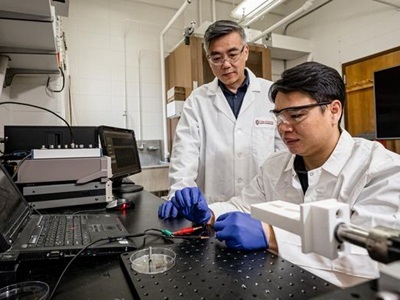
A new oscillating triboelectric nanogenerator developed by Professor Xudong Wang and postdoctoral scholar Pengfei Chen could power a pacemaker for a patient’s entire life, no batteries needed. Credit: Joel Hallberg / UW–Madison
Engineers have built an implantable, battery-free pacemaker that's charged by a patient's own heartbeat. The device has the potential to last an entire lifetime, reducing the risks and costs associated with replacing the devices when their batteries fail.
Today's leadless pacemakers deliver faster recovery and fewer complications than older devices, but their batteries make up more than half their size and typically last just seven to 10 years.
Because removing an implant from inside the heart is difficult, expired devices are often left in place when a new one is inserted—a particular problem for younger patients who may need multiple replacements over their lifetime. Researchers have explored tritium batteries and other energy-harvesting technologies, but none produce enough power to run an intracardiac pacemaker—until now.
The team at the University of Wisconsin–Madison designed specialized oscillating triboelectric structures sized to fit inside the battery compartment of the Medtronic Micra, the most common leadless intracardiac pacemaker. The oscillators are built from pairs of electrode plates—one coated with positive copper, the other with a negative fluorinated ethylene propylene film. When a patient's heart beats, the motion compresses the oscillators, bringing the oppositely charged plates together; when they separate, the movement generates an electrical charge that powers the pacemaker or charges a small onboard capacitor.
In the study, published in Science Advances, tests showed the new nanogenerator produces 276.6 microwatts per cubic centimeter, a power density an order of magnitude higher than earlier nanogenerator designs.
The team implanted a prototype in a pig for a month and found it successfully powered cardiac stimulation without adverse effects beyond those seen with conventional battery-powered devices.
“For a device like this, it's not just about producing energy. Power density is the most important part. You need to get enough power in a small enough volume,” said study author Xudong Wang, professor of materials science and engineering at UW–Madison.
However, inside the pig's heart, the nanogenerator didn't reach the same power peak it hit in lab testing, largely because soft heart tissue dampens the oscillator's mechanical movement, and the heart's twisting motion differs from the up-and-down motion the device is optimized for.
The researchers are now refining the design to better capture that irregular motion. They have registered the device with the Wisconsin Alumni Research Foundation, though says commercialization and possible clinical deployment will take years.
Data from University of Wisconsin–Madison