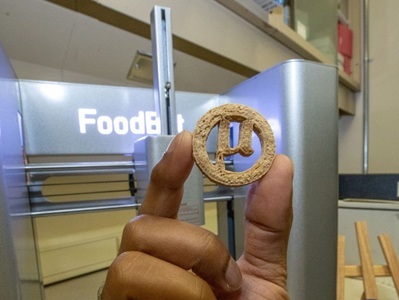
This cookie is made using waste plant materials and plastic and could feed humans everywhere from submarines to spaceships. Credit: SIU Carbondale Communications
Researchers at Southern Illinois University Carbondale have programmed yeasts to convert plastic and agricultural waste into edible proteins and flavoring molecules, producing a cookie-like food that could eventually support disaster relief or deep-space missions.
For the project, presented at the fall meeting of the American Chemical Society, researchers, working as part of a NASA-led effort, took polyethylene terephthalate (PET) along with discarded corn stalks, leaves and other biomass, and ran it through a proprietary process called oxidative hydrothermal dissolution. The process uses water and oxygen at high temperature and pressure to break tough material down into pieces small enough for microbes to consume.
The team then fed those pieces to a variety of programmed yeasts, including baker's yeast, which reformed the carbon-rich molecules into new food ingredients such as proteins, fats and acids. The researchers added fiber, starch and sweetener to the mixture, then extruded it through a 3D printer to form protein-rich cookies the team calls µBites, pronounced “microbites.”
“We were trying to develop technologies for plastic upcycling to make more valuable products. We thought, why not focus on making food? Because plastic is carbon and food is carbon," said Lahiru Jayakody, associate professor at SIU Carbondale.
Scientists have used microbes as miniature factories for decades—insulin, for example, is no longer extracted from animal pancreases but produced by programmed yeast. Jayakody said the same logic applies here.
“Microbes are very clever,” he said. “So, we are using their traits to solve the problems we created.”
Data show the cookies are safe to eat, though the team is still awaiting institutional approval to conduct formal taste tests. In informal evaluations, the cookies scored well on aroma, and most participants said they'd be willing to eat them in resource-limited situations.
To make µBites more appealing under normal circumstances, Jayasekara engineered additional yeast strains—one that produces vanilla flavoring from plant biomass, and another that converts ethylene glycol from PET into beta-carotene, which the body can turn into vitamin A.
Jayakody and his team hope to eventually produce the cookies' remaining ingredients—including the starch, fiber and sweetener—using microbes as well. They hope µBites could be ready for public consumption within a few years, with applications ranging from submarines to lunar or Martian colonies.
“Global food demand is expected to rise 35–56% by the year 2050, and about 30% of the world population will be at risk of hunger in the future,” Jayakody said. “The way to address that, I believe, is by using microbes.”
Data from American Chemical Society