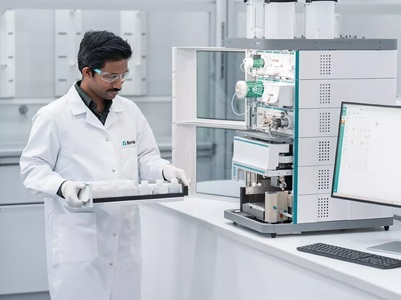
Metrohm introduces OMNIS IC, the next-generation ion chromatography system designed to combine maximum flexibility, automation, and reliability on a single analytical platform. Built on a modular hardware concept and powered by intuitive software, OMNIS IC addresses both current and future analytical demands while ensuring efficiency and reproducible results.
OMNIS IC is based on a modular hardware concept comprising functional units such as pumps, injectors, detectors, and dosing units. These components can be combined as needed to create a customized ion chromatography system. This modularity allows laboratories to configure systems precisely according to their analytical requirements and to expand them easily as applications grow in complexity.
OMNIS IC supports a high degree of automation, covering workflows from sample preparation through to result validation. Automated eluent preparation and continuous monitoring of fill levels help prevent interruptions. Inline sample preparation steps – such as dilution, filtration, and dialysis – and intelligent injection techniques – such as partial loop injection, preconcentration, or matrix elimination – reduce manual intervention and minimize the risk of user errors.
To ensure stable and reproducible results, OMNIS IC continuously monitors system status, including pressures, flows, and liquid levels. Pre-run checks validate sample lists, while equilibration checks ensure that measurements begin only under stable conditions. Functions such as AutoPurge and AutoRinse help maintain a gas-free flow path and prevent sample carryover between runs.
OMNIS IC is operated via the OMNIS Software, which features a clearly structured and intuitive user interface. Visual icons, dropdown menus, tooltips, and integrated help functions support fast familiarization, enabling both experienced analysts and new users to work efficiently and confidently.
OMNIS IC is fully integrated into the OMNIS platform, enabling ion chromatography, titration, and near-infrared spectroscopy to be controlled within a single software environment. Analytical results from different techniques are consolidated on a sample-centric basis, breaking up data silos and simplifying reporting – for example, in applications such as drinking water analysis.