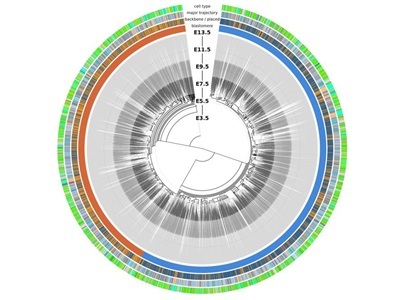
Circular lineage tree of a 13-day old mouse embryo originating from a single cell at the center expanding outward over developmental time. Cells derived from the first cell division are marked in blue or red. Credit: Seattle Hub for Synthetic Biology
Researchers from the Seattle Hub have successfully built a time-calibrated lineage tree showing how a single cell turns into 1.28 million—about 10% of the cells in a two-week-old mouse embryo. This is by far the largest lineage tree ever built for a mammal.
It partially answers a question that has plagued science for decades: how does a single fertilized egg produce all the cells in an animal’s body?
In the study, published in Science, researchers used a technology called DNA Typewriter to reconstruct most of the cell lineage of a developing mouse, mapping how more than 1.28 million individual cells emerged from the first cell division to form tissues and organs.
DNA Typewriter works by inserting sequential genetic stamps into a cell’s DNA as it divides. The stamps are copied into every daughter cell and written in order, revealing how a cell divided and what happened to it when it did.
Researchers injected the DNA Typewriter system into a fertilized mouse egg and let the embryo develop for 13.5 days, around two-thirds of the way through mouse gestation. They measured the genetic stamps in 1.58 million individual cell nuclei and reconstructed the “family tree” of cells composing the embryo.
According to the study results, researchers identified multiple unique marks at the first cell division. As the cells continued to divide into more cells on two parallel but different tracks, researchers found they contributed a different number of total cells to the embryo—about 57% to 42%—but provided the same proportion of every cell type.
This research is a critical first step because learning how cells divide and organize during development could help better understand birth defects, cancer and developmental disorders. By understanding the path of normal cellular development and how one cell becomes many, researchers have a reference model for comparison that can better identify when and where the normal path diverges into diseases. This knowledge can help researchers develop ways to prevent abnormal cellular development or intervene when cells go astray.
Data from the Allen Institute