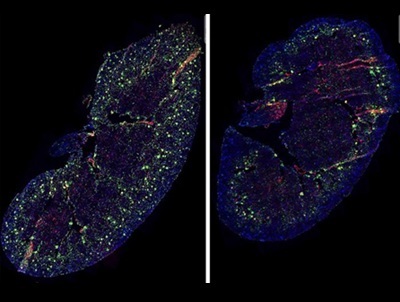
Kidney sections from aged wild-type (left) and GzmK-deficient mice (right). Normal ageing is associated with enlargement of the kidney’s filtering units (glomerular hypertrophy) and substantial deposition of inflammatory complement proteins (green). In mice lacking GzmK, both glomerular enlargement and complement deposition are markedly reduced, indicating protection against age-related kidney damage. Credit: Nicole La Gruta, Monash Biomedicine Discovery Institute (BDI)
Monash University researchers have identified a protein that drives age-related damage in vital organs, opening a potential new avenue for treatments that could help people stay healthier as they get older.
Published in Immunity, the research discovered a link between the protein Granzyme K and signs of aging in the heart, liver and kidneys.
Granzyme K is a protein produced by immune cells, with levels known to increase significantly with age in both mice and humans, but its precise role in age-related organ damage has remained unclear.
The study used preclinical or mouse models, comparing older mice that did not have the protein Granzyme K with those that did.
In mice lacking Granzyme K, researchers observed significantly improved heart function and reduced fibrosis, a form of scarring that can affect how well the organ works.
The mice also showed reduced signs of age-related damage in their liver and kidneys.
Upon examining human datasets, the researchers found elevated levels of Granzyme K in patients with several inflammatory and fibrotic diseases, including lupus nephritis and heart failure.
“This challenges the long-held assumption that organ and immune ageing are inextricably linked and opens up an exciting new avenue for developing treatments that could help people maintain healthier organs for longer,” said senior researcher and study author Nicole La Gruta.
The researchers are now investigating ways to selectively block Granzyme K to determine whether targeting the protein later in life could provide similar protection.
"Because these mice have lived their entire lives without Granzyme K, we now need to understand whether blocking the protein later in life could achieve similar benefits,” said La Gruta.
Further research is also needed to determine whether the same benefits could be achieved in humans.
"There's still a lot of work to do, but identifying a protein that contributes to damage across multiple organs gives us a promising new direction for research into healthier aging,” said said La Gruta.
Data from Monash University