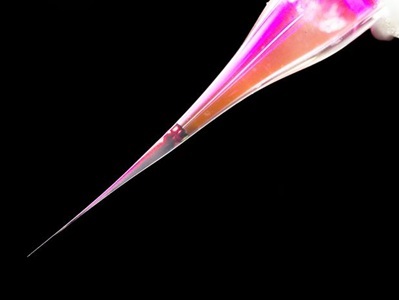
Researchers at Linköping University have developed a new type of pipette that can deliver ions to individual neurons without affecting the sensitive extracellular milieu. Credit: Thor Balkhed
Researchers at Linköping University have developed a new type of pipette that can deliver ions to individual neurons without affecting the sensitive extracellular milieu.
Previous attempts to change the extracellular milieu have primarily involved pumping in some form of liquid. But this means that the delicate biochemical balance is disturbed, making it difficult to know whether it is the substances in the fluid, the changed pressure or the extracellular fluid swirling around that leads to the activity.
To get around the problem, the research team developed a micropipette measuring only 2 micrometres (mm) in diameter. The pipette is manufactured by heating up a glass tube and pulling it to the breaking point. This produces a very thin and tapered tip. The “iontronic micropipette” has a tip filled with a specially adapted ion-exchange membrane, which makes it possible to create activity by chemical means. Other than that, it looks identical to the traditional micropipette, and is controlled in a similar way.
Using the iontonic micropipette, the researchers can add only ions, such as potassium and sodium, to the extracellular milieu to see how this affects the neurons. Glial cell, specifically astrocyte, activity is also measured. The team conducted experiments on slices of hippocampus brain tissue from mice.
“The neurons didn’t respond as quickly to the change in ion concentration as we had initially expected. However, the astrocytes responded directly and very dynamically. Only when these were ‘saturated’ were the nerve cells activated. This highlighted the fine-tuned dynamics between different types of cells in the brain in a way that other technologies haven’t managed to do,” said researcher Theresia Arbring Sjöström.
The next step is to continue studying chemical signaling in both healthy and diseased brain tissue using the micropipette. The researchers also want to develop the delivery of medical drugs and study its effect against neurological diseases, such as epilepsy.