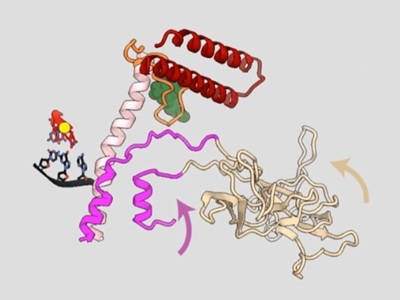
The Darst Lab has shown how two classes of antibiotics (pictured in green) jam the enzyme responsible for the transcription of DNA to RNA. They do this by locking a key structural component in place. Credit: Darst Lab at Rockefeller
Researchers at Rockefeller University have identified a previously unknown moving part inside RNA polymerase by studying how two experimental classes of antibiotics disable it.
The team used cryo-electron microscopy to capture RNA polymerase in action in both E. coli and the bacterium that causes tuberculosis. Scientists had long known that two experimental antibiotics—CBR9379 and AAP-SO2—could halt gene expression in these pathogens by binding to specific spots on the enzyme, but traditional X-ray crystallography couldn't reveal exactly what process the drugs were interfering with as it captures static snapshots rather than the enzyme's constant shape-shifting as it builds RNA.
By sorting thousands of cryo-EM images into distinct structural states, the researchers found that a component called the trigger loop, already known to open and close with each new RNA building block, works together with a neighboring structure called the rim helices/F-loop that had not previously been shown to move at all. As the trigger loop closes, the rim helices/F-loop swings into place and briefly stabilizes it. When the antibiotics were added, they locked the rim helices/F-loop in its open position, preventing that stabilizing contact and halting RNA synthesis entirely.
“Without the inhibitor, the enzymes were in two prominent states, closed and open,” said study author Yukti Dhingra, a postdoctoral associate who worked on the project. “But when we added the inhibitor, the closed state disappeared entirely. We were looking at an ensemble of different conformations and, with the addition of the antibiotic, we could see the ensemble shift.”
Because the same mechanism appeared in both E. coli and the tuberculosis bacterium—two organisms that are evolutionarily distant—the researchers say the movement is likely a fundamental requirement for RNA polymerase across many forms of life.
Beyond the basic biology, the team says the discovery offers a structural blueprint for developing new antibiotics that target a vulnerability unique to bacterial RNA polymerase—a mechanism distinct from rifampicin, the cornerstone of current tuberculosis treatment. Because these compounds work differently than rifampicin, earlier research suggests they could eventually be combined with it to create a more effective treatment cocktail as resistance to existing tuberculosis drugs continues to rise.
Data from Rockefeller University