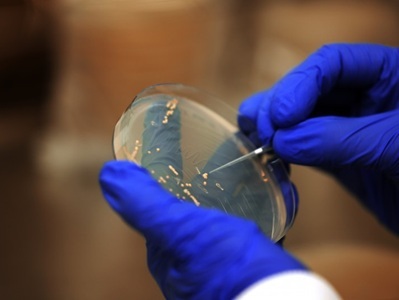
The colonies of baker’s yeast grown on this agar plate have been genetically engineered to make M2 proteins, which are essential for producing new viruses. Credit: Brenda Ahearn/Michigan Engineering, Communications & Marketing. Regents of the University of Michigan, 2026.
Nearly every flu vaccine given today is still made using an 80-year-old method—growing the virus in chicken eggs—a process that's slow, expensive and struggles to keep pace with new mutant strains.
Now, researchers at the University of Michigan have developed an alternative: a fast, inexpensive and safe method for manufacturing flu vaccines in baker's yeast that, in early mouse studies, provided broad, long-lasting protection against multiple influenza strains.
The researchers presented their findings at the American Chemical Society's fall meeting, held Aug. 23-27 in Chicago.
HA, M2, and a ‘lifelong’ vaccine
Despite decades of research, scientists have struggled to develop a universal flu vaccine that offers broad, long-lasting protection across strains and subtypes. Most existing vaccines target hemagglutinin (HA), a viral surface protein that triggers a strong immune response but mutates rapidly—which is why a new vaccine, and another shot, is needed nearly every year.
Trang Hoang, a graduate student at the University of Michigan, instead targeted M2, a viral protein essential to producing new viruses.
“The influenza M2 protein is far less prone to mutation than HA,” Hoang said. “M2 has remained relatively conserved since the 1918 flu pandemic and shows high sequence conservation across human, swine and avian influenza A strains.” By targeting a highly conserved protein like M2, Hoang hopes a resulting vaccine could provide protection lasting well beyond a single flu season—potentially even a lifetime.
Hoang and team also set out to build a faster, more cost-effective manufacturing system that skips chicken eggs altogether. Their approach used baker's yeast, or Saccharomyces cerevisiae, to produce virus-like particles (VLPs) that display the M2 protein on their surface.
To build the VLPs, Hoang edited the yeast genome so the cells would produce large amounts of M2, then incubated the modified yeast in a nutrient-rich liquid. She treated the yeast with mild reagents to gently strip its rigid cell wall, before separating and purifying the M2 VLPs by centrifugation.
Hoang then vaccinated 18 mice with the purified M2 VLPs to test whether they would trigger a strong immune response. Blood serum from the vaccinated mice showed abundant antibodies against M2 from five different influenza strains. When Hoang exposed the vaccinated mice to three of those strains, all of them were protected from infection.
While the results are promising, the researchers say more work is needed before a universal flu vaccine could move to human trials, including determining how long M2 VLP-induced immunity lasts.
The team has already licensed the technology to a company developing yeast-based systems for oral vaccines. They envision a future where engineered yeast strains could be “brewed” as oral vaccines for influenza and other diseases.
“It sounds like science fiction, but we're very excited by the potential of this yeast-based vaccine production system,” Hoang said.