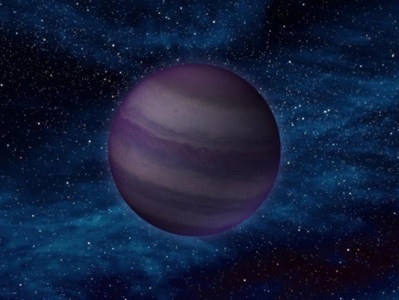
Artist's concept of a brown dwarf. Brown dwarfs begin their lives like stars but they never accumulate enough mass to fuse atoms steadily at their cores and ignite with starlight. Credit: NASA/JPL-Caltech
A Jupiter-sized world just 7.5 light-years away is cloudy, chemically complex, and, it turns out, more like home than anyone expected.
Using the James Webb Space Telescope (JWST), Brittany Miles, assistant astronomer at University of Arizona Steward Observatory, led a team that spent 11 hours staring at WISE 0855—the coldest known brown dwarf—collecting a spectrum of its light every 15 minutes. The result is the first direct confirmation that water clouds on another body are changing thickness over time, just like weather on Earth.
“This is the first time we've been able to confirm that water clouds are becoming thinner and thicker on a nearby world,” said Miles. “Before JWST, we only had photometry, which mixed up the effects of clouds, chemistry and temperature all together. Now, we can actually distinguish them.”
As WISE 0855 rotates, different patches of its surface rotate into view, each with slightly different cloud cover and temperature. In this study, JWST's medium-resolution spectrograph was able to track those differences across individual molecular features. The spectrograph also captured a rhythmic, wave-like signal tied to carbon monoxide and phosphine.
This kind of chemical signal—where heat from deep inside the brown dwarf is churning gasses upward toward the surface—is one planetary scientists have seen before. On Jupiter, convective mixing dredges gases from deep, hot layers up into the visible atmosphere. The process, called disequilibrium chemistry, has been observed in brown dwarfs before—but watching it vary in real time, molecule by molecule, is new territory.
The authors say one of the biggest findings of the study is that the basic physics of convection, clouds and chemistry that govern Jupiter also govern this cold, free-floating world. If that physics is universal, it applies to the gas giant exoplanets that astronomers are now beginning to study with JWST.
Miles looks ahead to logging more hours of baseline observations with JWST to pin down further details about WISE 0855's rotation and 3D nuances of its atmospheric movement. For now, the message is clear: weather happens everywhere, and some of our closest neighbors have skies worth watching.
Data from University of Arizona